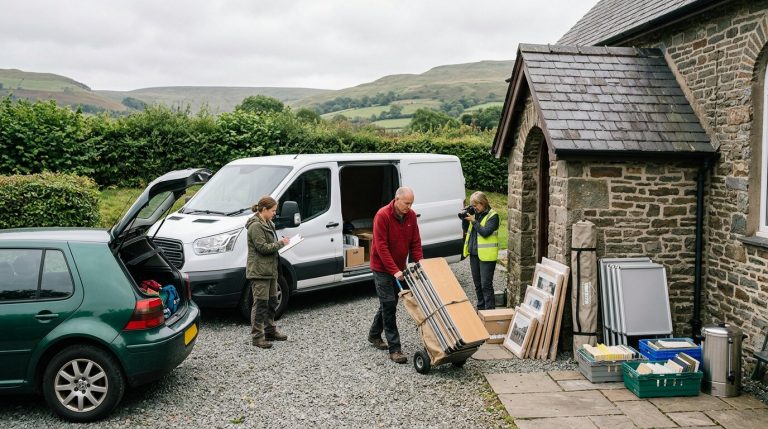
Most heritage open days in Wales are run by small groups: a chapel committee, a local history society, the friends of a ruined abbey. The talks and tours tend to get planned months ahead. The transport often gets sorted the week before, usually by whoever owns the biggest car.
That works until it doesn’t. A short answer for organisers: list every object that has to reach the site, decide how the people will get there separately from the kit, and only then work out whether you need to hire anything. Most groups find they need less than they feared, but the bit they do need is worth booking early, because September weekends are busy for everyone.
Start with the event you have actually agreed
Before thinking about vehicles, pin down the basics with the site owner or manager. Which day, what hours, and when can you get in to set up? Can a vehicle reach the door, or will everything be carried from a car park? Who unlocks the gate, and who locks it again at the end?
Many local events sit under the banner of Open Doors, Wales’s contribution to European Heritage Days, which Cadw funds and organises each September. Being part of a national programme helps with publicity, but it will not tell you how far your nearest parking space is from a church porch. Only the site can answer that, so ask for it in writing, along with any rules on vehicles crossing grass or stopping near fragile stonework.
Count the kit before you count the cars
Walk round the room where the display is stored and write everything down. It is the single most useful thing you can do, and it usually reveals two or three heavy or awkward items nobody had mentioned.
The checklist below is meant to be copied and filled in. The last column is the one that decides whether you need a van at all.
| Item | Quantity and size | Who brings it | Fits in a car? |
|---|---|---|---|
| Signs: A-boards, directional arrows, banners, stakes | Note the longest pole or banner | Long items often decide this on their own | |
| Display furniture: folding tables, pop-up boards, easels, cases | Note weight of the heaviest piece | ||
| Exhibits: framed photographs, models, archive boxes | Note anything fragile or irreplaceable | Fragile items travel best with the person responsible for them | |
| Hospitality: urn, cups, gazebo, chairs | |||
| Power and safety: extension leads, first aid kit, torches | |||
| Volunteers: names, arrival time, who can carry | Number of people | Travel separately from the kit | People need proper seats, never the load space |
| Access: drop-off point, carry distance, steps, gate times, site contact | Carry distance in metres | Site contact name only | A trolley may matter more than the vehicle |
Keep people and equipment apart
This is where well-meaning plans go wrong. A van is for cargo. Volunteers travel in the cab seats or in cars, and nobody rides in the back with the display boards.
If the group is large enough to justify a minibus, check the licence rules before anyone volunteers to drive. GOV.UK’s minibus guidance says a car licence holder can drive a minibus in the UK without passengers paying only if certain conditions are met. Among them: the driver is 21 or over, has held a licence for at least two years, drives on a voluntary basis for social purposes on behalf of a non-commercial body, there’s no trailer, and the minibus has up to 16 passenger seats and is within the weight limit. Drivers aged 70 or over must also meet Group 2 medical standards. If you can’t meet every condition, a car licence isn’t enough: the driver may need D1 entitlement, and charging for the trip raises a separate permit question. A permit doesn’t replace the driver’s own licence requirements. Read the full page, check your licence entitlement and the hirer’s terms, and tell the hirer who will be driving.
For a van, the general limit for a standard car licence is 3,500kg maximum authorised mass for petrol or diesel vehicles, as set out on GOV.UK’s licence categories page. Most panel vans hired for this kind of job fall within that, but ask for the plated weight of the vehicle you are actually given.
Two enquiry options to check
Where you look for a vehicle depends on where the kit is stored, not where the event is. A society in mid Wales and a group in the Valleys will start in different places. The two boxes below are examples for those two areas. They are not a comparison, and neither business has been assessed by this site.
Newtown, Powys
Website: vehicle hire information for Newtown
What the page lists: car, van, minibus and truck hire for Newtown and surrounding areas, with delivery and collection mentioned. The page says enquiries are handled by phone.
Worth asking: which specific vehicle you would get, whether delivery to a heritage site is possible, the insurance excess, and the exact return time.
Ebbw Vale, Blaenau Gwent
Website: van availability in Ebbw Vale
What the page lists: van hire among other vehicle types, from a small van up to a Luton with a tail lift, described on vanhiretredegar.co.uk’s Ebbw Vale service page, with delivery and collection mentioned.
Worth asking: whether a tail lift is available on the date you need, the payload of the actual van, the deposit, and whether out-of-hours return is possible after a late finish.
Contact details are not repeated here. Check them on each website and confirm terms directly before booking.
Plan the loading, not just the journey
Don’t assume a hired van comes with shelving, straps or tie-down equipment. Ask the hirer what the exact vehicle has, because a glass display case can slide into the bulkhead on the first roundabout if nothing holds it. GOV.UK’s load-securing guidance for vans suggests loading items against the bulkhead, grouping smaller items in boxes or containers, and securing large or heavy items to the vehicle. In practice that means bringing straps and blankets, and packing loose leaflets and small objects into crates rather than letting them roam.
Load in reverse: what you need first on site goes in last. Signs usually come out first, because they need to be up before visitors arrive.
Book the return as carefully as the collection
Open days end tired. Volunteers drift off, it’s getting dark, and the person with the van keys is still talking to the last visitor. Decide in advance:
- who packs, and in what order;
- where the kit is going back to, and whether someone will be there to unlock;
- when the hire vehicle must be returned, and what happens if you are late;
- who checks the vehicle is empty and photographs the fuel gauge.
A hypothetical example: a chapel group running a Saturday event books a van from Friday afternoon to Sunday morning. That costs an extra day, but it means the display is loaded calmly the evening before and returned after a night’s sleep, rather than in a rush at six o’clock on Saturday with half the volunteers already gone.
The kit list you made at the start is worth keeping. Next year, it becomes the first draft of the plan.
